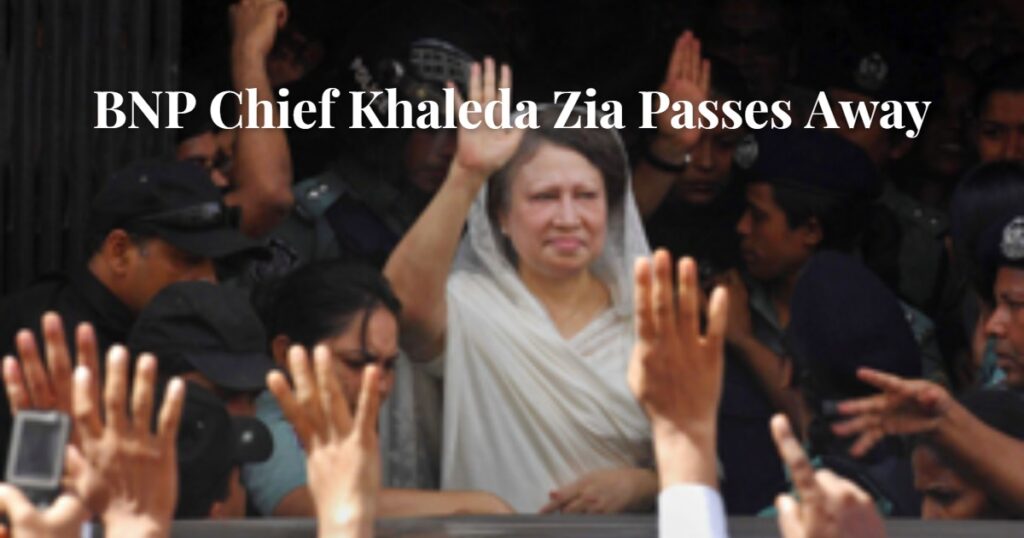
Bangladesh is mourning the death of former Prime Minister Khaleda Zia, the country’s first woman premier and a central figure in its turbulent political history, who died in Dhaka on 30 December 2025 at the age of 80. Her passing marks the end of an era defined by intense rivalry, military legacies and a decades-long struggle over the direction of Bangladeshi democracy.
When and how Khaleda Zia died
Khaleda Zia passed away at Evercare Hospital in Dhaka, where she had been admitted on 23 November 2025 with serious complications involving her lungs, liver and heart. Doctors had described her condition as “extremely critical,” and she was placed on advanced life support in her final days before the Bangladesh Nationalist Party (BNP) announced that she died around 6 am on 30 December.
In the weeks leading up to her death, her medical team reported worsening pneumonia, advanced liver cirrhosis and cardiac issues, and at one stage discussed the possibility of sending her abroad for treatment. Those plans were ultimately shelved after doctors concluded she was too frail to withstand international travel, leaving her to spend her final weeks under intensive care in Dhaka.
A life shaped by power and rivalry
Born in 1945, Khaleda Zia emerged from relative obscurity after the assassination of her husband, President Ziaur Rahman, in 1981, eventually taking over leadership of the BNP and becoming a symbol of resistance to military-backed rule. She served three terms as prime minister—1991–1996, 2001–2006 and briefly in 1996—steering Bangladesh through economic liberalisation, energy expansion and controversial security crackdowns.
Her political life was defined by a bitter, often violent rivalry with Awami League leader Sheikh Hasina, with the two women dominating Bangladesh’s politics for more than three decades. Street clashes, hartals (strikes) and accusations of authoritarianism became hallmarks of the era, earning the pair the moniker of the “Battling Begums” in global media coverage.

Years of imprisonment, illness and eventual acquittal
Khaleda’s final decade was overshadowed by corruption cases, imprisonment and chronic illness. In 2018, she was jailed after being convicted in embezzlement cases related to an orphanage trust, charges she insisted were politically motivated attempts by the Hasina government to remove her from electoral politics.
Her health deteriorated sharply in custody, and in 2020 she was moved to house arrest on humanitarian grounds, barred from active politics and initially forbidden from travelling abroad. Following the fall of the Sheikh Hasina government amid a student-led uprising in August 2024, an interim administration allowed her full release, and in November 2024 the Supreme Court acquitted her in the graft cases, formally clearing her name.
Final months: hope, treatment abroad and return home
After her legal acquittal, many supporters believed Khaleda Zia might still play a role in shaping Bangladesh’s political transition, even if not as a direct electoral contender. In January 2025, she travelled to London for advanced medical treatment, spending nearly four months abroad before returning to Dhaka in May.
Back home, however, her underlying conditions continued to worsen. She was hospitalised again on 23 November 2025 with severe lung infection and multiple organ complications, and despite intensive treatment, her medical team and family had to prepare the nation for an outcome they increasingly described as inevitable.
National mourning and global reactions
News of Khaleda Zia’s death prompted immediate scenes of grief outside Evercare Hospital and at BNP offices, where thousands of supporters gathered to pay their respects. The BNP declared a period of national mourning within the party, calling her “our beloved leader” and vowing to carry forward her political vision.
Leaders from across the political spectrum and the region also offered condolences. India announced that External Affairs Minister S. Jaishankar would attend her funeral in Dhaka, while Prime Minister Narendra Modi and other South Asian leaders paid tribute to her role as Bangladesh’s first female prime minister and a key figure in shaping regional relations.
Legacy of Bangladesh’s first woman prime minister
Khaleda Zia leaves behind a deeply contested yet undeniably significant legacy. Supporters hail her as a champion of multi‑party democracy who challenged one‑party dominance and stood firm against military interference, particularly during the turbulent 1990s transition from autocracy to elected government.
Critics point to the corruption cases, governance controversies and periods of political paralysis under her watch, as well as accusations that both her party and the Awami League eroded institutions in their quest for power. Yet even her opponents acknowledge that her presence, alongside Sheikh Hasina, defined an era in which Bangladeshi politics revolved around two powerful women with sharply different visions of the state.
What her death means for Bangladesh’s politics
Khaleda Zia’s death leaves the Bangladesh Nationalist Party facing a succession test at a critical moment. Her elder son Tarique Rahman, long seen as her political heir and operating largely from exile, now becomes the undisputed focal point of BNP leadership, though questions remain over how effectively he can command support across grassroots networks shaped by his mother.
For Bangladesh as a whole, her passing potentially closes the chapter of personalised rivalry that dominated the political landscape since the 1990s, opening space for a younger generation of leaders who did not directly fight the liberation war or come of age during military rule. Whether that leads to more consensus‑driven politics or simply ushers in new forms of confrontation will depend on how both BNP and its rivals choose to interpret Khaleda Zia’s complex, polarising and historic legacy.