
By Investigative Desk
AHMEDABAD / VADODARA — As millions across the country prepare to travel home to celebrate upcoming festivities with families, a quiet economic crisis unfolds across digital booking portals. What was promised to the Indian middle class as affordable aviation infrastructure under regional connectivity schemes has morphed into an unchecked extractive system, turning emergency travel and festive homecomings into financially punishing ordeals.
A hard analytical review of real-time flight inventory data between Vadodara (BDQ) and Patna (PAT) reveals an alarming surge in airfares for last-minute and short-horizon bookings—exposing how algorithmic dynamic pricing operates without moral or social guardrails, prioritizing extreme profit extraction over basic public service responsibilities.
The Reality of the Numbers: Real-Time Data Breakdown
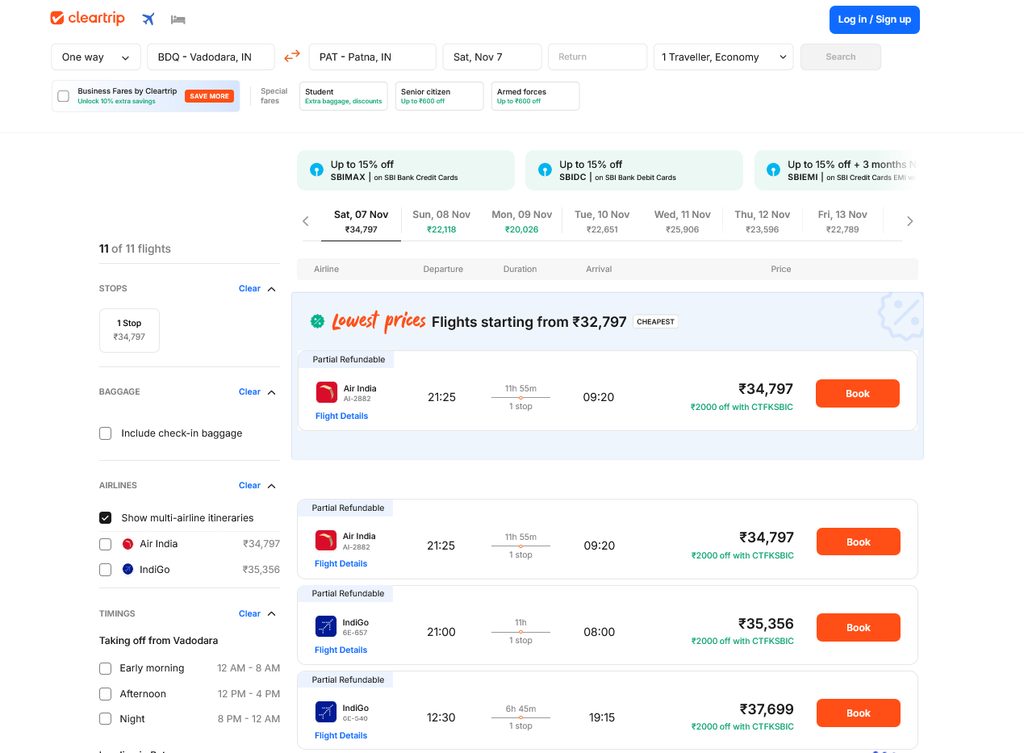
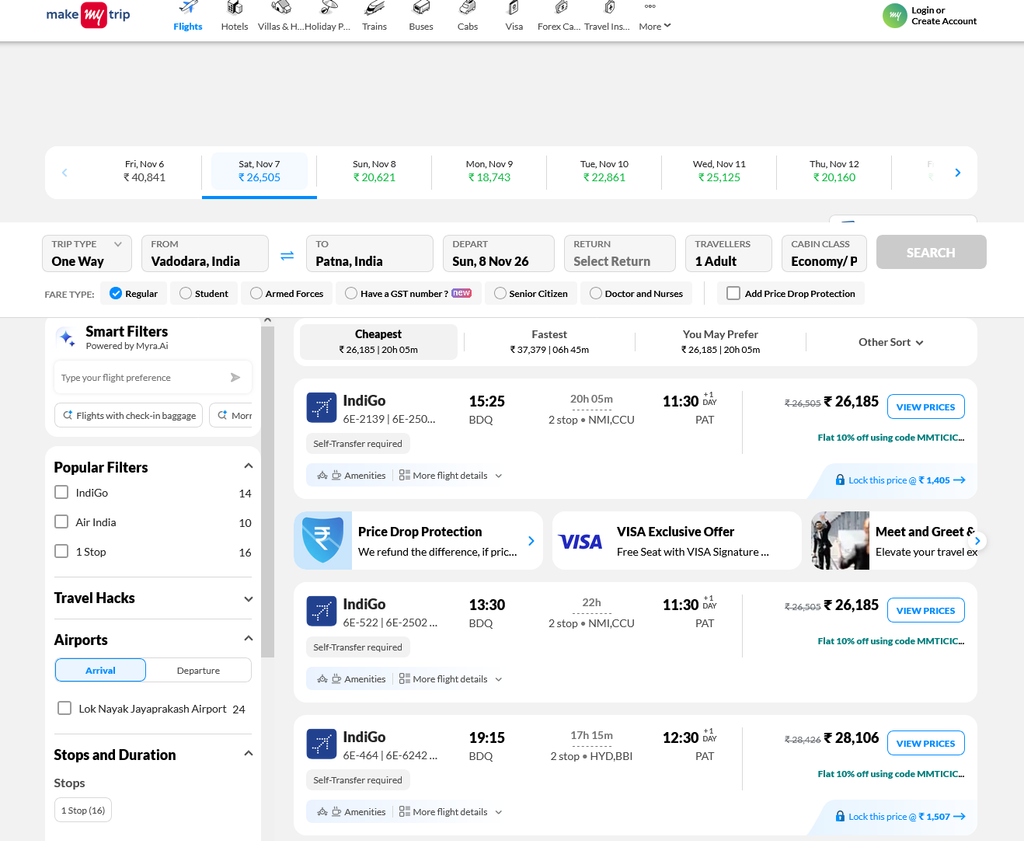
An analysis of live inventory across major booking engines (MakeMyTrip and Cleartrip) for travel from Vadodara to Patna illustrates the sheer scale of price gouging:
| Platform | Travel Date | Route | Airline / Flight | Duration / Layover | Fare (Economy Class) |
| MakeMyTrip | Fri, Nov 6 (Same Day) | BDQ – PAT | Various | Various | ₹40,841 |
| MakeMyTrip | Sat, Nov 7 (24-48 hrs) | BDQ – PAT | IndiGo (6E-2139 / 6E-250…) | 20h 05m (2 stops via NMI/CCU) | ₹26,185 |
| MakeMyTrip | Sat, Nov 7 (24-48 hrs) | BDQ – PAT | IndiGo (6E-464 / 6E-6242…) | 17h 15m (2 stops via HYD/BBI) | ₹28,106 |
| Cleartrip | Sat, Nov 7 (24-48 hrs) | BDQ – PAT | Air India (AI-2882) | 11h 55m (1 stop) | ₹34,797 |
| Cleartrip | Sat, Nov 7 (24-48 hrs) | BDQ – PAT | IndiGo (6E-657) | 11h 00m (1 stop) | ₹35,356 |
| Cleartrip | Sat, Nov 7 (24-48 hrs) | BDQ – PAT | IndiGo (6E-540) | 06h 45m (1 stop) | ₹37,699 |
Key Empirical Takeaways
1. The Instant-Booking Extortion (Same-Day Spike)
Same-day travel on November 6 spikes to ₹40,841 for a domestic economy seat. A passenger needing to travel urgently due to a family emergency or medical necessity is hit with a fare equivalent to international long-haul flights to Europe or the Middle East.
2. The 24-to-48-Hour Trap
For bookings within 24 to 48 hours (Saturday, November 7), standard domestic economy tickets range from ₹26,185 to ₹37,699. Even for multi-stop itineraries with 17 to 20 hours of travel time involving self-transfers, airlines demand upwards of ₹26,000.
3. The Festive Arbitrage
As shown in the date bar across platforms, fares gradually ease toward mid-week (dropping to ₹18,743–₹20,160 around Nov 9–12), proving that early November weekend surge pricing isn’t driven by actual jet-fuel cost spikes or airport tariff hikes. It is purely driven by automated yield management systems designed to squeeze citizens when their demand is least price-sensitive.
The Corporate Mirage: Profiteering Masked as “Algorithmic Pricing”
Airlines routinely defend these hyper-inflated prices under the umbrella of “dynamic yield management”—an automated system that adjusts fares based on remaining seats and real-time demand. However, this defense relies on a fundamental mischaracterization of essential public infrastructure.
- Airlines are Public Utility Carriers, Not Pure Speculative Assets: Commercial aviation operates using public infrastructure—airports funded by tax revenues, state-subsidized regional connectivity frameworks (UDAN), and allocated national airspace. When airlines exploit festival rushes or emergency travel windows, they treat public airspace as a closed casino where distressed passengers pay whatever ransom algorithm demands.
- Artificial Scarcity & Route Monopolies: Non-metro to tier-2 routes (like Vadodara to Patna) suffer from low direct frequency. Instead of deploying additional capacity during peak festive demand, carriers throttle capacity, forcing passengers onto convoluted 2-stop flights while charging premium rates of ₹35,000+ per passenger.
- Absence of Corporate Social Responsibility (CSR) in Pricing: While commercial enterprises exist to generate profit, basic civil aviation standards require a duty of care. Charging ₹37,000 for a 6-hour domestic layover flight during a major cultural festival demonstrates an absolute abandonment of social accountability.
Questions for Key Aviation & Regulatory Authorities
1. Ministry of Civil Aviation (MoCA)
- The Policy Deficit: While the Ministry has declined to implement festive fare caps—relying instead on “advisories” to airlines—how does MoCA justify leaving citizens unprotected against 400%–700% price hikes during national festivals?
- Public Asset Exploitation: Airlines operate using publicly funded airport infrastructure and state-subsidized aviation ecosystems. Why is there no statutory requirement for airlines to provide a minimum quota of affordable seats on non-metro routes during peak travel periods?
2. Directorate General of Civil Aviation (DGCA)
- Tariff Monitoring Oversight: DGCA’s Air Transport Regulations state that airline tariffs must remain reasonable and consider operational costs. How does the regulator audit revenue management algorithms that price a domestic 2-stop economy ticket at ₹37,699?
- Capacity Throttling: Why does the regulator allow carriers to reduce or restrict direct frequency on heavy migration routes (like Gujarat to Bihar/Uttar Pradesh) during peak demand, forcing passengers onto expensive multi-stop routes?
3. Competition Commission of India (CCI)
- Duopolistic Market Power: With domestic aviation heavily consolidated between two major airline groups holding over 85% market share, has tacit collusion or algorithmic price-matching been investigated on high-demand festive routes?
- Exploitative Pricing: Does the CCI consider charging over ₹40,000 for a domestic economy seat an abuse of collective dominance during periods of zero consumer choice?
4. Consumer Protection & Public Welfare Standards
- Emergency Protection: Why are there no emergency provisions or statutory ceilings for passengers who must travel on 24-to-48 hours’ notice for family emergencies or bereavements?
The Urgent Need for Regulatory Capping
When corporate entities operate without structural limits on essential public transport, consumers are left completely vulnerable. The current hands-off regulatory framework allows carriers to act as predatory tolls on internal migration.
To protect citizens from predatory pricing during festive seasons and medical emergencies, regulatory authorities must consider immediate policy interventions:
- Festive Dynamic Fare Caps: Establishing mandatory price ceilings on domestic economy routes during recognized national peak travel periods (e.g., maximum capping scaled to flight distance).
- Emergency Last-Minute Quotas: Mandating a small percentage of late-booking seats reserved at reasonable, capped rates for documented medical or family emergencies.
- Capacity Expansion Mandates: Requiring dominant domestic carriers to deploy additional seasonal capacity on high-demand tier-2 and tier-3 corridors, preventing artificial scarcity.
Until statutory guardrails are established, automated yield algorithms will continue to treat the emotional and urgent needs of ordinary citizens as revenue targets—milking family reunions and emergency journeys for maximum corporate gain.