The memoir ‘Four Stars of Destiny’ by General MM Naravane has raised concerns about military transparency and political discourse in India prior to its release.
General MM Naravane’s memoir “Four Stars of Destiny” has become the centre of a major political storm in India even before its formal release, after Indian opposition leader Rahul Gandhi cited alleged excerpts in Parliament to question the government’s handling of the 2020 China border crisis. The row has raised big questions about civil–military transparency, government clearance of military books, and the rights and limits of political debate using material that is officially still “unpublished”.
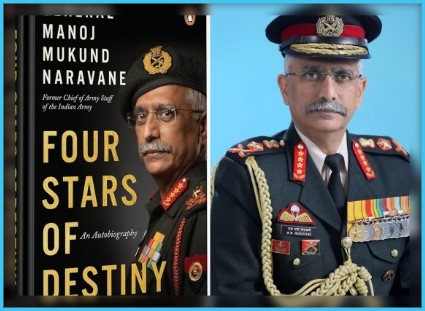
Who is General MM Naravane and what is his book?
General Manoj Mukund Naravane (Retd) served as the Chief of Army Staff from December 2019 to April 2022, a tenure that covered the Galwan Valley clash and the wider India–China standoff in eastern Ladakh. Before becoming Army Chief, he held key posts including Vice Chief of Army Staff and General Officer Commanding‑in‑Chief of Eastern Command, giving him a front‑row view of India’s major operational theatres.
His memoir, titled “Four Stars of Destiny”, is described by the publisher as a personal and professional account of his journey from cadet to four‑star general, with detailed chapters on:
- The 2020 Ladakh crisis and Galwan clash.
- Operational decision‑making at the highest levels.
- The rollout of reforms like the Agnipath scheme, which Naravane reportedly called a “bolt out of the blue” for the services.
- Internal functioning of the civil–military apparatus.
The book was originally expected to be released in late 2023/early 2024, and major retailers like Amazon had listed it for pre‑order with Penguin Random House India as the publisher. However, publication was delayed because the manuscript was sent for official clearance by the Ministry of Defence and related ministries, a standard process for books by senior serving or recently retired military officers that may contain sensitive operational details.
As of early 2026:
- The book has been written and submitted to the publisher.
- It has not received final government clearance, so the publisher says it is not formally published.
- Listings exist, but copies remain “unavailable” or pulled from public sale.
This “limbo” status is exactly what set the stage for the Rahul Gandhi controversy.
Why is “Four Stars of Destiny” stuck? The clearance issue
For books by former chiefs and other top officers, the government typically insists on a pre‑publication review to ensure that operational secrets, classified intelligence or sensitive diplomatic details are not inadvertently disclosed.
Reports note that:
- Naravane’s manuscript has been with the Defence Ministry and possibly the External Affairs Ministry for vetting since around 2023.
- The publisher has publicly stated that the memoir is not banned, but is awaiting government approval, which explains why its release has repeatedly slipped.
- Commentators and some former officials argue that the unusually long delay is linked to the political sensitivity of chapters on the Ladakh standoff, the China policy, and critiques of how reforms like Agnipath were sprung on the forces.
This bureaucratic limbo led to a peculiar situation: the book exists, but only in private circulation and internal copies, not as a publicly released volume. It is this gap that Rahul Gandhi stepped into during the Budget Session of 2026.
What does Naravane reportedly say about the 2020 China standoff?
According to multiple media outlets that have seen or been briefed on the manuscript, Naravane’s memoir includes some sharp passages about the 2020 Ladakh crisis. Key reported elements include:
- Naravane describes being given what he calls a “hot potato” in August 2020, when the Chinese army moved aggressively along the Line of Actual Control (LAC) and Indian forces had to respond quickly.
- He reportedly writes that the decision to fire on Chinese troops if they entered Indian territory was devolved down without clear top‑political instructions, leaving him feeling “isolated” and “forsaken by the entire establishment” during a crucial phase of the standoff.
- The memoir is said to mention that Prime Minister Narendra Modi’s message, as interpreted by Naravane, was essentially along the lines of “do what you think is appropriate,” which Naravane experienced as a lack of explicit political ownership of escalation decisions.
Because the book is not officially available, these are reported excerpts and summaries, not text the public can verify line‑by‑line. Nevertheless, they form the core of what Rahul Gandhi highlighted.
Rahul Gandhi’s use of the book and the parliamentary clash
The immediate controversy began when Rahul Gandhi, Leader of the Opposition, attempted to quote from “Four Stars of Destiny” during a parliamentary debate in early February 2026.
Key events in sequence:
- During the Budget Session, Gandhi tried to read passages from Naravane’s memoir in the Lok Sabha to argue that the Prime Minister had “abandoned responsibility” at a critical moment in the 2020 Ladakh crisis.
- Treasury bench members objected, arguing that Gandhi was quoting from an unpublished, un‑cleared manuscript that could contain sensitive information, and that discussing it on the floor of the House posed national‑security concerns.
- Outside Parliament, Gandhi held up what he said was a copy of “Four Stars of Destiny” and reiterated that Naravane felt “alone and abandoned by the entire establishment” when Chinese tanks reached the Kailash Ridge.
- He framed this as proof that the government had failed to provide decisive political direction to the Army in 2020, and demanded that the Prime Minister respond in Parliament on the China issue.
The government’s response was sharp: ministers and ruling‑party MPs accused Gandhi of being “irresponsible” and “anti‑national” for citing allegedly sensitive operational accounts from a book still under official review.
The publisher vs Rahul Gandhi: “Is the book published or not?”
After Gandhi dramatically waved the book before cameras, Penguin Random House India, which holds the rights to Naravane’s memoir, issued statements that deepened the mystery instead of closing it.
According to detailed reports:
- Penguin reiterated that the book has not been officially published, and that it cannot be sold or circulated commercially until government clearance is granted.
- At the same time, screenshots surfaced of an earlier social‑media post by Naravane himself, telling followers to “follow the link” to buy his book on Amazon—apparently from a period when the publisher and platforms had prepared for a 2024 release.
- The apparent contradiction—author promoting a link vs publisher insisting the book is not yet out—allowed Gandhi to claim that Penguin was “hiding” behind the clearance process, while he was simply bringing the truth to light.
Gandhi publicly said he trusted Naravane’s account over the publisher’s statements, and repeated that the real issue was government transparency on the 2020 China standoff, not the publication technicalities.
FIR, “leak” concerns and national security debate
The row escalated from a political argument to a legal battle when reports emerged that Delhi Police had registered an FIR into the alleged circulation of the unpublished book.
Key concerns raised by authorities and security commentators include:
- If the manuscript is still under official review, any physical or digital copies in circulation may be considered sensitive; using them publicly could, in theory, breach confidentiality or the Official Secrets Act, depending on content.
- Questions arose about how Gandhi obtained the copy—whether from the author, the publisher, a reviewer, or via an unauthorised leak inside the clearance system.
- Some former officials argue that even if political debate is legitimate, quoting internal assessments about live border issues in a charged parliamentary environment risks giving adversaries insights into internal decision‑making and perceived civil–military gaps.
At the same time, civil‑liberties voices and sections of the opposition say the FIR is an overreach, and that citizens and MPs have a right to discuss how the government handled a crisis that cost Indian soldiers’ lives.
What General Naravane himself has said
Naravane has not publicly confirmed or denied each of the specific lines quoted by Rahul Gandhi, but some broad points are on record:
- He has acknowledged in earlier interviews and festival appearances that the manuscript was with the publisher and under government review, and that certain operational details would need careful handling.
- He has also spoken, in separate contexts, about the pressure of the 2020 China standoff, and about how reforms like Agnipath came as a surprise to the armed forces.
- After the latest political storm, he has largely avoided explicit partisan commentary, maintaining a professional distance while the clearance and legal processes play out.
In other words, much of what is being debated today is interpretation of reported excerpts, not a fully public, finalized text.
Why this controversy matters: bigger themes
Beyond personalities, the Naravane–Rahul Gandhi book row touches several deeper issues:
- Civil–military transparency vs secrecy
- Democracies benefit when senior military leaders document their experiences, but operational detail can’t simply be dumped into the public domain.
- The long, opaque clearance delays for “Four Stars of Destiny” raise questions about whether the process is being used to genuinely protect security or to avoid political embarrassment.
- Political use of military narratives
- Gandhi’s move shows how military memoirs can become political ammunition, especially on sensitive topics like China policy and border management.
- The government’s strong pushback, including the FIR, signals that it sees this as crossing a line between legitimate debate and national‑security risk.
- Information control in the digital age
- Even if a book is “unpublished” formally, digital files, advance copies and leaks make total control almost impossible.
- Once excerpts are read out in Parliament or shown on TV, trying to suppress discussion often backfires, drawing more attention—as visible in the sustained media coverage of this row.
- Precedent for future military authors
Key points and FAQs
What is “Four Stars of Destiny”?
It is the unpublished memoir of former Indian Army Chief General MM Naravane, covering his personal journey and major events like the 2020 India–China border standoff and internal defence reforms.
Is General Naravane’s book banned?
No. The book is not banned; it is awaiting government clearance, so the publisher has not officially released it yet.
Why is Rahul Gandhi involved in the Naravane book controversy?
Rahul Gandhi cited alleged excerpts from the memoir in Parliament to argue that the Prime Minister did not give clear instructions during the 2020 Ladakh crisis, sparking a political and legal row.
How did Rahul Gandhi get an unpublished book?
That is precisely one of the questions being investigated; media reports say police have registered an FIR into the circulation of the unpublished manuscript, and the publisher denies having released it.
What does the Naravane book reportedly say about the China standoff?
Reports suggest Naravane describes being left to take key calls on firing and escalation, feeling “isolated” and “forsaken” by the establishment during a critical phase of the 2020 Ladakh crisis—claims the government has not accepted in public.
Conclusion: an unfinished story
Until “Four Stars of Destiny” is formally cleared and published, the public will only see fragments—reported excerpts, political interpretations and official denials. But the controversy around Rahul Gandhi and General Naravane’s book has already ensured that, whenever it does appear, it will be one of the most closely scrutinised military memoirs in recent Indian history, and a touchstone for debates on how India confronts China, manages its armed forces and balances secrecy with accountability in a democracy.